FILM ART AND CULTURE REVIEW
30.10.2026Prime Time – When Suffering Becomes Entertainment
BFI London Film Festival 2026 | Review
Like many other film lovers, I had been really looking forward to Prime Time. I was lucky enough to see it early as a member of the press, and unfortunately, I didn't love it as much as I thought I would.
Which is a shame, because there are things about this film that I genuinely appreciated, especially the performances.
I really liked Skyler Gisondo playing the protagonist. What I found particularly interesting was how he portrayed someone who knows, at least at the beginning, that what he's doing is strange, even morally questionable, but somehow manages to convince himself that it's just part of the job.
And I don't think we can even call it acting, at least not in the traditional sense. After all, pretending to be someone else, playing a role or hiding your real emotions is something people do in everyday life too.
But then something changes. He becomes so involved in the programme that he ends up hosting an entire episode on his own, genuinely emotionally invested in something that was supposed to be just a television show.
I also really appreciated Merritt Wever playing the producer. She manages to make you understand exactly what kind of person this woman is, without needing to explain it constantly.
She doesn't really care about anyone but herself. Even when another job opportunity comes along, everything is about what she can get out of it. And by the final episode, when everything has gone completely wrong, she's still thinking about how they could use what happened to create more television.
That, to me, says everything about her character.
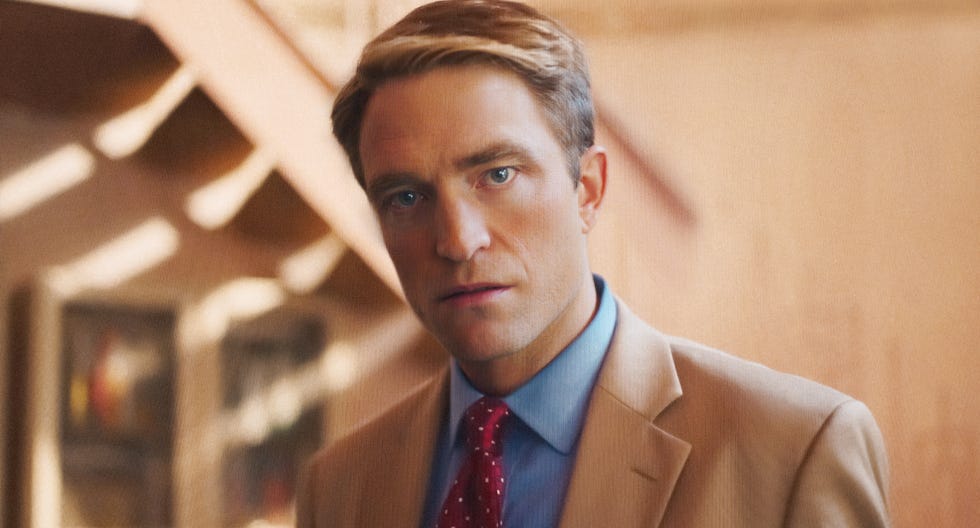
And then there's Robert Pattinson.
My friend Tony, who is also a journalist, made a comparison that I found really interesting: Pattinson's acting is becoming more and more similar to Nicolas Cage's.
And I can see what he means. He uses his entire face when he acts. His eyes, his mouth, the smallest changes in expression. Sometimes you can almost see the character thinking before he even says anything. I've liked Pattinson since Remember Me, and it's interesting to see how much his approach to acting has developed.
But despite all of this, I had one big problem with Prime Time.
I constantly felt like the film was trying to tell me how I was supposed to feel about what I was watching.
And at the same time, it never really goes deep enough into the things it wants to talk about.
We see this television industry that is desperate for entertainment, but also wants to be taken seriously as a source of information. There are moments when the film tries to explore the difference between journalism and entertainment, like when another reporter is talking about Iraq, or when we see Saddam Hussein on television.
And I found those moments interesting, because there's clearly something there worth exploring.
You have a world that is falling apart, wars happening, political crises, and at the same time people are watching a television programme built around somebody else's suffering.
But the thing is, I don't think these are two completely separate realities.
Social isolation, mental health problems, paedophilia, people struggling to find their place in society. These are also part of a world that is falling apart, just in a different way.
And instead of really exploring that connection, the film seems more interested in reminding us that what we're watching is wrong.
Yes, we know it's wrong. But why does it happen? Why do people want to watch it? Why does television keep turning other people's problems into entertainment? And what does that say about us?
Those are the questions I wanted the film to spend more time on.
Sometimes I almost felt like Prime Time was afraid of going too far with its own ideas.
It could have been something much bigger, almost a portrait of an entire period in television history, rather than a film so specifically focused on one programme.
And I think that's what disappointed me the most. Because the material is there, the performances are there, but the film never quite takes that extra step.
I did appreciate the visual style, though. The colours, the sets, the whole atmosphere feel very early 2000s.
As an Italian, it actually reminded me of programmes like Passaparola, with the Letterine, or Striscia la Notizia. That kind of television where everything was colourful, loud, full of familiar faces, and where entertainment was constantly being pushed in front of you.
I grew up with that television, so I recognised the atmosphere immediately.
But again, something was missing.
I wanted to watch this film and have that moment of thinking, "Oh my God, yes. This is exactly what we were watching. This is what we grew up with. And somehow, television is still doing the same thing to us today."
Because that's the point, isn't it? We might not have exactly the same programmes anymore, but we're still consuming people's lives, problems and suffering as entertainment. Sometimes we're even more involved in it now than we were back then.
And I don't think Prime Time really manages to make that connection.
So, unfortunately, I'm giving it 3 out of 5.
Not because I think it's a bad film. I don't. There are some really good performances, and I genuinely think the story has so much potential.
Actually, I'd love to see someone revisit it in a few years. Maybe through a sequel, maybe through another adaptation, or even just a film that takes these same ideas and looks at them from a wider perspective.
Especially considering what's happening today, with social media, reality television and the way we keep turning real people's experiences into content.
There's so much more to say about all of this, and I wish Prime Time had been a little braver in saying it.
Because I didn't need the film to tell me that this kind of entertainment is morally questionable.
I wanted it to make me think about why we keep watching it anyway.
SHARE
Share this article
Hook
BFI London Film Festival 2026 | Review
Keywords
prime · time · suffering · becomes · entertainment
Hashtags
#CinematicLife #Prime #Time #Suffering #Becomes
COMMENTS
Join the conversation
No comments yet. Be the first to leave one.